OpenCoF logo OpenCoF

Learning to Reason Through Video Generation

Xinyan Chen1,2,*, Ziyu Guo3,*, Renrui Zhang1,†, Dongzhi Jiang1,2, Hongsheng Li2
1ByteDance Seed    2CUHK MMLab    3CUHK IMIXR
*Equal contribution    Corresponding author (renruizhang@bytedance.com)

Introduction

OpenCoF studies Chain-of-Frame (CoF) reasoning, where a video generation model reasons through the temporal evolution of its own generated frames rather than through static images or externally invoked tools. We construct OpenCoF-17K, a dataset of 17,312 videos across 11 task families built from four complementary curation pipelines, and use it to fine-tune Wan2.2-I2V-A14B into Wan-CoF, which improves over the baseline on four independent external benchmarks—MME-CoF, Gen-ViRe, VIPER, and RULER-Bench—purely from data supervision. Building on this, we further introduce two complementary reasoning-token designs, Visual Reasoning Tokens (vt) and Textual Reasoning Tokens (tt), yielding Wan-CoFvt and Wan-CoFtt, which improve further while specializing in different strengths across benchmarks.
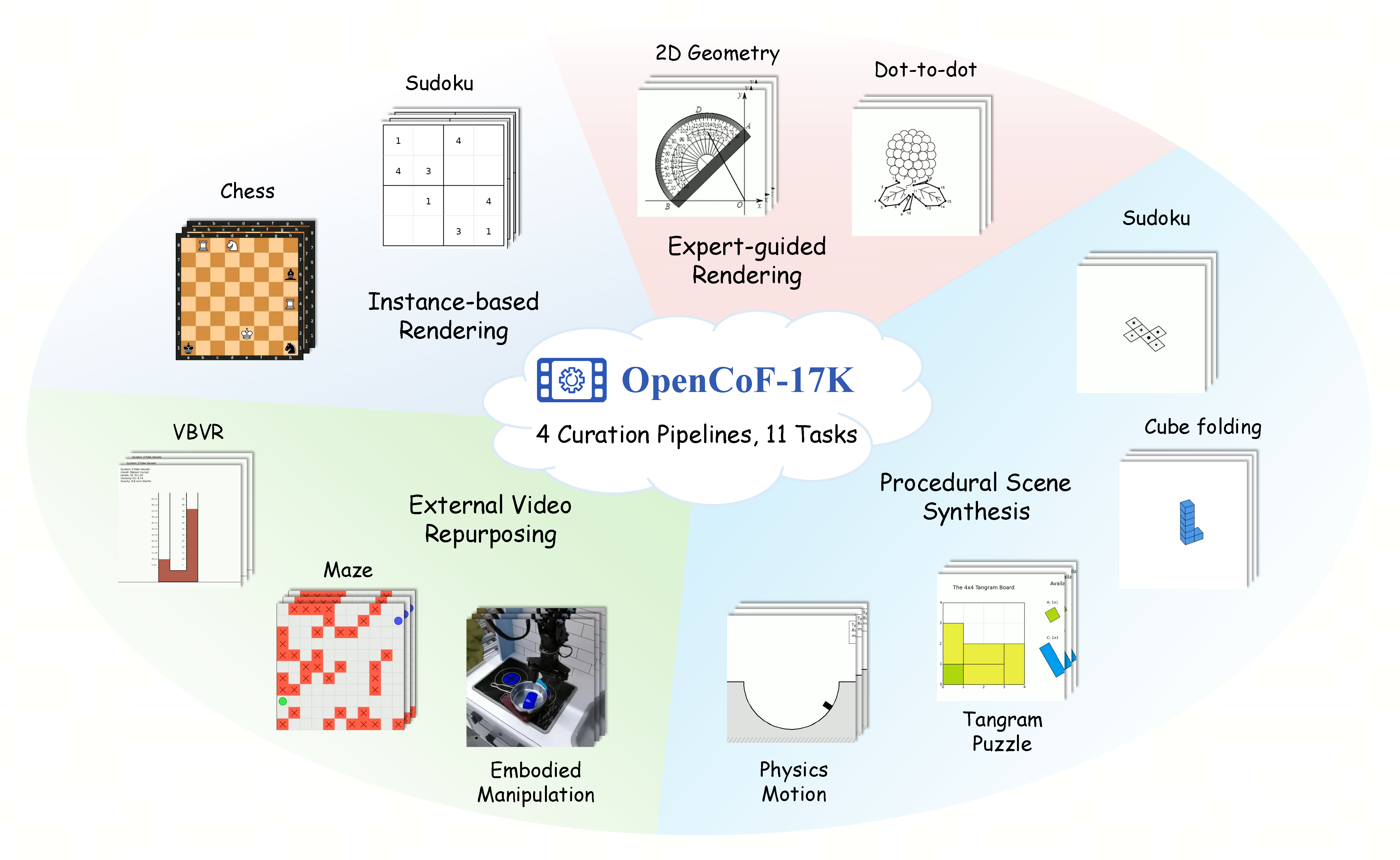
Overview of OpenCoF-17K: four curation pipelines spanning 11 task families

OpenCoF-17K

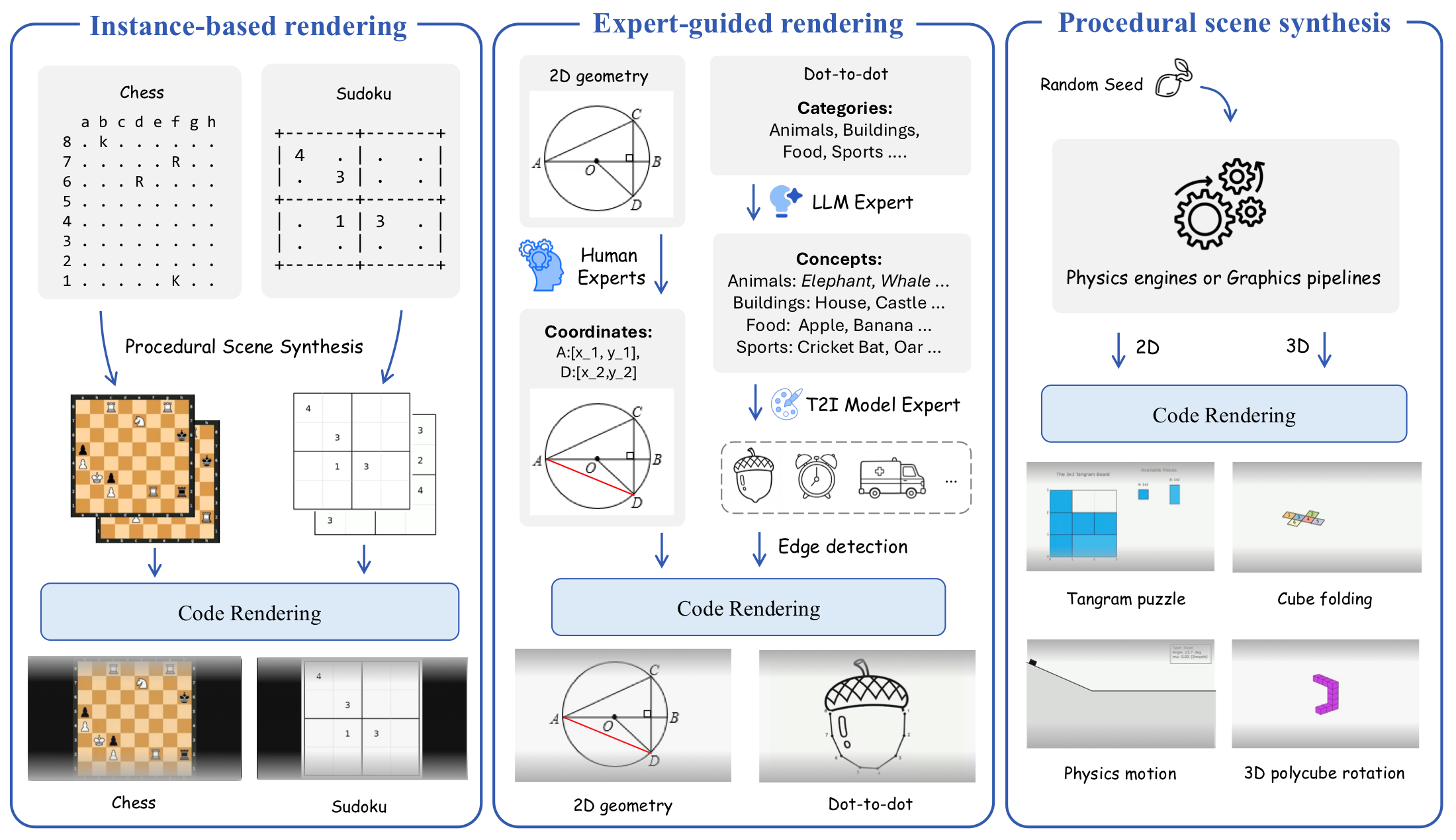
OpenCoF-17K contains 17,312 samples across 11 task families. Each instance pairs an initial conditioning image and text prompt with a target reasoning video standardized to 480p, 15 fps, and 81 frames. It is curated through four complementary pipelines: instance-based and expert-guided rendering produce precise, rule-governed videos for tasks like chess, Sudoku, and geometry; procedural scene synthesis renders physics- and 3D-grounded motions with graphics engines; and repurposing of existing videos adds real-world diversity such as embodied manipulation.

OpenCoF dataset curation pipeline

Exploration of CoF Techniques

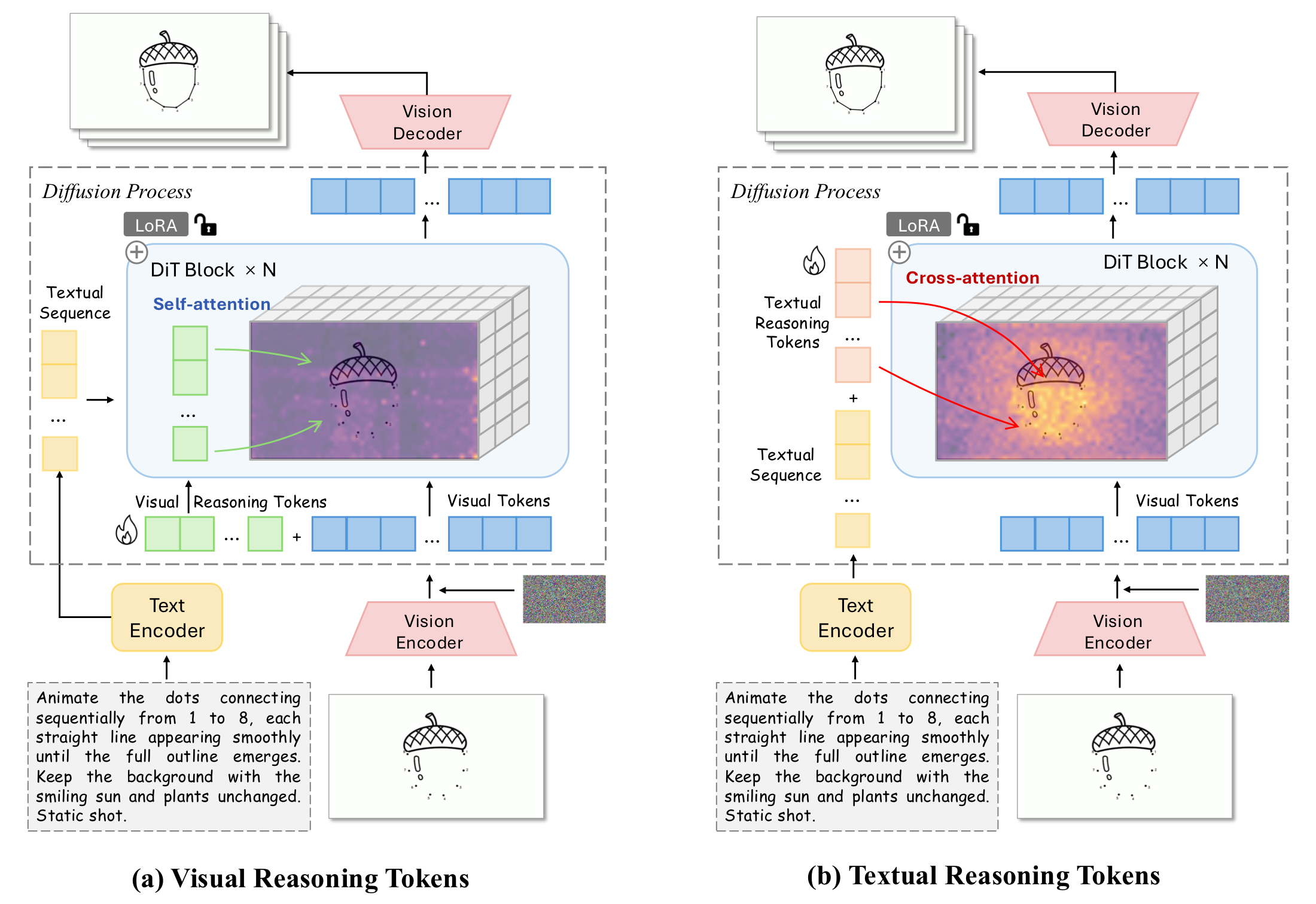
Wan-CoF is obtained by LoRA fine-tuning Wan2.2-I2V-A14B on OpenCoF-17K. Building on this data-only stage, we explore two complementary reasoning-token designs: Visual Reasoning Tokens (vt), prepended to the visual latent sequence to capture low-level cues via self-attention, and Textual Reasoning Tokens (tt), prepended to the text-conditioning sequence to supply a high-level semantic prior via cross-attention. Training each separately yields Wan-CoFvt and Wan-CoFtt.

OpenCoF reasoning-token method figure

Results

Wan-CoF improves the Wan2.2-I2V-A14B baseline on every headline metric across four external video reasoning benchmarks—MME-CoF, Gen-ViRe, VIPER, and RULER-Bench—despite being trained with no reasoning-specific machinery at all. The reasoning-token variants push further still and specialize in complementary directions: Wan-CoFvt leads on Gen-ViRe and RULER-Bench, while Wan-CoFtt leads on MME-CoF and VIPER.

Model MME-CoF (0–4) Gen-ViRe (0–1) VIPER (0–100) RULER-Bench (0–100)
Overall Instr.
Align.
Temporal
Cons.
Visual
Stab.
Content
Fid.
Focus
Rel.
Overall Abstract Algo.&
Logi.
Analogy Percept. Planning Spatio-
Temp.
Overall Temporal Struct. Symbolic Spatial Physics Planning Overall Vision
Avg.
Science
Avg.
Game
Avg.
Human.
Avg.
Wan2.2-I2V-A14B Baseline 1.000.220.961.520.681.62 0.3040.2200.3590.0830.1900.5190.452 3.35.66.20.00.02.85.3 55.854.354.945.671.2
Wan-CoF 1.30 +0.300.311.291.991.001.89 0.391 +0.0870.3280.5060.1330.3470.5780.451 7.5 +4.218.810.00.05.38.35.3 56.8 +1.054.654.652.669.3
Wan-CoFvt 1.340.261.382.330.991.76 0.4410.4750.5070.2330.2980.6280.507 8.212.811.30.04.08.315.8 59.659.853.553.275.6
Wan-CoFtt 1.350.341.272.181.171.77 0.4060.4240.4740.1670.3060.5650.499 8.814.815.00.08.02.810.5 57.757.854.853.870.8

Citation

@article{chen2026opencof,
  title   = {OpenCoF: Learning to Reason Through Video Generation},
  author  = {Chen, Xinyan and Guo, Ziyu and Zhang, Renrui and Jiang, Dongzhi and Li, Hongsheng},
  journal = {arXiv preprint arXiv:2607.08763},
  year    = {2026}
}